The Seafood News


Just Discovered off the Scarborough Coast, this Maine Lobster is 1 in 50 Million
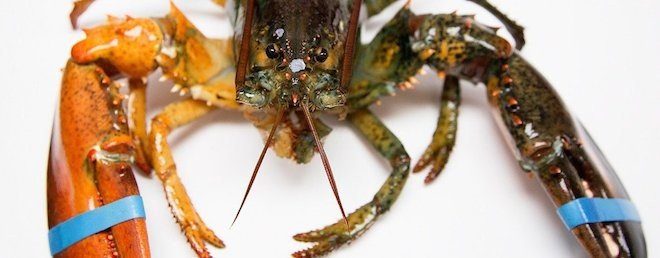
Maine lobsters, although the crème de la crème of crustaceans, typically don’t make the news, unless of course there is something extra ordinary about them. Caught off the coast of Scarborough, ME and discovered at the Pine Point Fisherman’s Co-Op, was one such lobster, an extremely rare, two-toned lobster. The Portland Press Herald reported the find on July 6th, stating that the rare Maine lobster arrived at the Point Fisherman’s Co-Op the week prior and the identity of the lobsterman who caught it is unknown.
According to researchers, this unique and very rare lobster is one of a kind, with a brown body, a half orange, half brown tail and one orange claw and one brown claw. In fact, it is so rare that your chances of finding one are one in 50 million, even rarer than the blue lobster at one in 2 million. According to the Lobster Institute at the University of Maine, the only lobster that is more rare is the albino lobster, which has no coloring at all.
But while two-toned lobsters are unique all in of themselves, this particular lobster is extra-ordinary due to its solid colored body and split colored tail and claws. Ordinarily, a split colored lobster is evenly divided from tail to claws with one color on one side and another color on the other side. What makes this lobster unique and extremely rare though, is its solid colored body combined with its split colored tail and claws. Adding to the intrigue is the fact that most split colored lobsters are hermaphrodites, but not this one. This rare Maine lobster is all female.
What causes a lobster’s color?
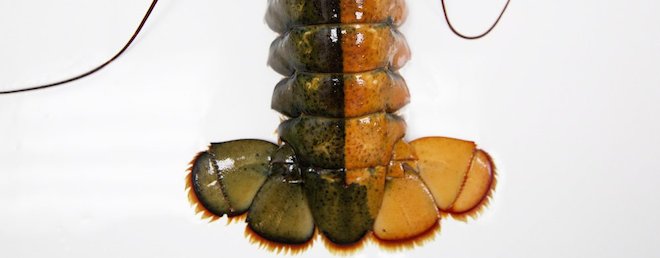 Photo by Portland Press Herald staff photographer, Yoon S. Byun/Staff Photographer
So why do lobsters come in different colors? Just like humans, lobsters come in different shades due to inherited pigmentation. While humans have a pigment called melanin, which determines skin color, lobsters have a pigment called astaxanthin, which determines shell color. In its natural state, astaxanthin is red but changes color when combined with certain proteins, causing lobsters varying shell colors. Rare colors or color combinations are the result of genetic defects that cause a lobster to produce more of a certain protein that then binds with the astaxanthin.
A blessing or a curse?
For the rare blue, white, red, calico and two-toned lobsters of the sea their unique coloring can be both a blessing and a curse. Most lobsters are a dark brownish green color (they don’t turn red until they are cooked), which bodes well for them in the murky depths of the ocean, where they can blend in and hide from predators. However, a blue, red or albino shell puts a lobster at a genetic disadvantage from the get go, giving them away to predators. Yet, what might be a disadvantage in the lobster’s natural habitat, can be a life saving trait once the lobster is caught and brought to land. Why? Because of their rarity they are typically brought to a museum instead of to a restaurant, where researchers are able to study them and eager onlookers can view their rare beauty in person.
As for now, the unique split colored Maine lobster found off of Scarborough lays in wait at the Pine Point Fisherman’s Co-op as researchers decide her fate, which will likely be a museum or the Maine State Aquarium in Boothbay.